Eagle Shawl Pattern

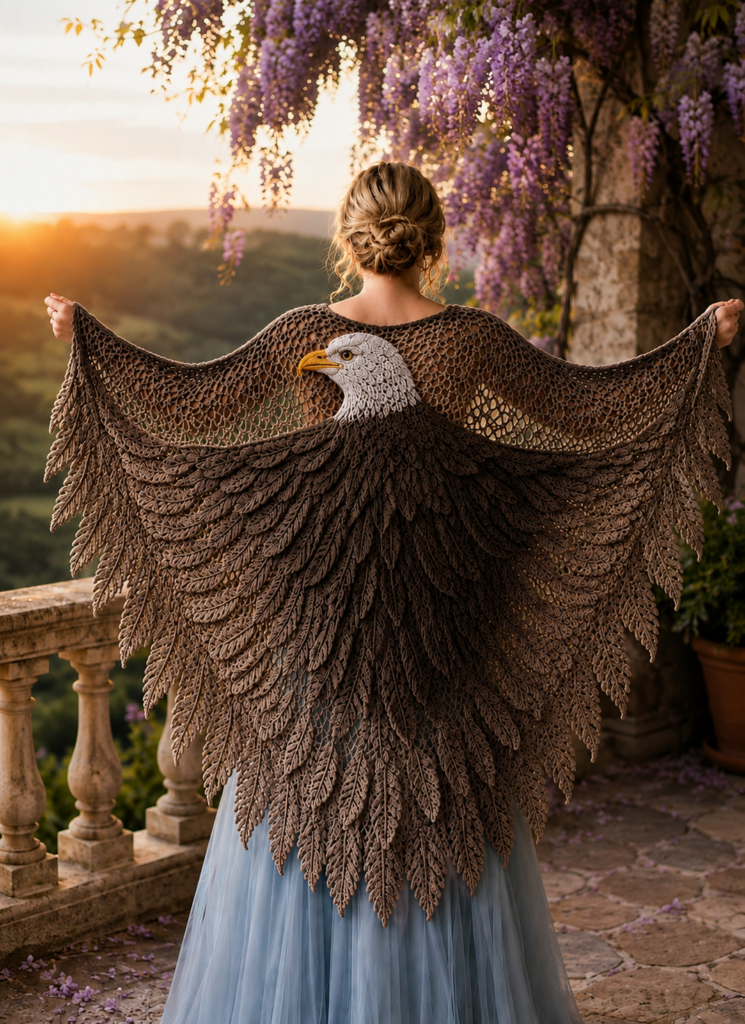
Eagle Shawl Pattern is a dramatic crochet project inspired by the powerful silhouette of an eagle spreading its wings. The design shown in the reference image combines an expansive triangular shawl construction with layered feather-like crochet sections, an open lace upper area, a sculptural central body, and a contrasting eagle head. When the wearer stretches both arms outward, the shawl creates the impression of enormous wings extending across the back, making this crochet eagle shawl as much a statement piece as a wearable accessory.
The beauty of an Eagle Shawl Pattern comes from combining several crochet techniques rather than relying on a single complicated stitch. Open chain spaces can create the lighter upper wing area, textured stitches build the central body, and repeated tapered motifs form the long feathers. The finished appearance may look intricate, but dividing the project into logical sections makes construction much easier. Crocheters who are comfortable with chains, single crochet, double crochet, increases, decreases, and working separate motifs can gradually build the design.
This tutorial uses U.S. crochet terminology and is intended as an adaptable interpretation of the eagle-inspired shawl shown in the image rather than an exact stitch-for-stitch reconstruction. Since yarn, tension, body size, and desired wingspan vary considerably, measurements are more useful than relying on one universal stitch count. A large adult version can measure approximately 65–75 inches (165–190 cm) from wingtip to wingtip, with a center-back depth of around 32–40 inches (81–102 cm). Make the shawl smaller or larger by changing the number of body rows and feather motifs.
For the main Eagle Shawl Pattern, choose a yarn with enough stitch definition to display the feather texture. A DK or light worsted-weight yarn is particularly useful because it produces visible detail without making such a large garment excessively heavy. Wool blends, acrylic blends, or smooth cotton blends can all work depending on the desired drape.
For a generously sized adult shawl, plan for approximately 1,800–2,600 yards (1,646–2,377 m) of yarn across all colors. The elaborate feathered version may require more. A practical palette would include approximately 70–80 percent brown for the wings and body, white or cream for the head, and a small quantity of golden yellow for the beak.
Try a 4.0 mm to 5.0 mm crochet hook as a starting point. The ideal hook depends on your yarn and tension. The fabric should remain flexible because a shawl needs movement, but the feather motifs should still have enough definition to maintain their shape.
Useful abbreviations for this project include ch (chain), sl st (slip stitch), sc (single crochet), hdc (half double crochet), dc (double crochet), tr (treble crochet), inc (increase), and dec (decrease). You may also use front-post or back-post stitches to create additional texture.
Begin the shawl at the upper center back. Ch 5 and join with a sl st to form a small ring. Alternatively, use a magic ring if you prefer a tighter starting point.
For the first foundation row, ch 3 and work approximately 3 dc, ch 2, 3 dc into the center ring. This establishes the center point from which the shawl can expand toward both wings.
Turn. On the next row, ch 3 and work dc across, increasing near the beginning, at the center space, and near the opposite end. The objective is to create a broad triangular or shallow crescent foundation rather than a narrow triangle.
Continue adding increases symmetrically. Maintain a clearly marked center stitch or center chain space. Consistent increases are essential because the shawl must remain balanced when stretched across the shoulders.
After several solid rows, introduce openwork. A sequence such as dc, ch 2, skip 2, dc creates the airy mesh visible across the upper portion of the reference shawl.
Alternate denser rows and open chain-space rows. This creates visual contrast while reducing the overall weight of the enormous wing area.
Continue until the upper foundation measures approximately 55–65 inches (140–165 cm) across. Remember that the additional outer feathers will increase the final wingspan considerably.
The spectacular feathers are the defining feature of this crochet Eagle Shawl Pattern. Rather than trying to create every feather directly within the main fabric, a manageable method is to crochet tapered feather motifs and attach them in overlapping rows.
Begin a feather with ch 18–30, depending on the desired length. Shorter feathers work near the shoulders and upper wings, while progressively longer feathers create the dramatic lower silhouette.
Starting in the second chain from the hook, work sc, hdc, dc, then several dc or tr stitches along the central portion. Near the opposite end, gradually reverse the sequence with dc, hdc, and sc. This creates a tapered shape.
Work along the opposite side of the foundation chain to form the second half of the feather. Keep both sides relatively symmetrical.
For additional texture, work a central line of slip stitches or surface crochet along the feather. This represents the shaft and makes each motif appear more dimensional.
A more elaborate feather can use alternating front loop and back loop stitches. These create subtle ridges resembling the natural structure of a bird feather.
Make the upper feathers approximately 6–8 inches (15–20 cm) long. Medium feathers can measure 9–12 inches (23–30 cm), while the dramatic lower center feathers may reach 14–18 inches (36–46 cm).
Begin attaching the first feather row along the lower edge of the shawl. Space the motifs closely enough that they overlap slightly.
Add the second feather row above the first so that the tips fall between the feathers underneath. This staggered placement is what creates the rich, layered appearance shown in the inspiration.
Continue toward the center back while gradually increasing feather length. The longest motifs should generally appear near the lower center of the shawl, creating a pronounced downward point.
Mirror the feather placement on the opposite wing. Perfect mathematical symmetry is not necessary, but the overall weight and silhouette should remain balanced.
To emphasize the wings, arrange feathers diagonally outward from the center. The direction of each motif matters almost as much as its shape. When the feathers radiate outward, the entire Eagle Shawl Pattern appears to spread naturally like a bird in flight.
Secure each motif firmly at its upper portion while leaving much of the lower feather free. This allows the layers to move independently and produces the dimensional effect seen in the reference.
The center section provides the visual focal point of the Eagle Shawl Pattern. It should appear denser and more textured than the open upper wings.
Beginning near the center back, create an elongated oval or tapered panel using rows of hdc and dc. Increase through the upper portion, work several rows evenly, and then gradually decrease toward the lower end.
Add texture using front post double crochet (FPdc), raised clusters, or surface crochet. Vertical ridges help suggest the layered breast feathers of an eagle.
You can also attach short individual feather motifs across this center section. Begin at the bottom and work upward so that each new row overlaps the previous one.
For the white eagle head, crochet a separate oval or rounded panel using cream or white yarn. Start with a short foundation chain and work around both sides of it, increasing at each end to create an oval.
Continue increasing until the head reaches approximately 7–9 inches (18–23 cm) across for a large adult shawl. Then work several rounds with fewer increases to create slight dimensional shaping.
To produce the feathered transition between the white head and dark body, finish the lower head edge with small pointed groups. For example, alternate sc, hdc, dc, hdc, sc across short sections.
The beak can be crocheted separately in golden yellow. Begin with a narrow chain and gradually increase to form a small tapered triangle or curved wedge.
Attach the beak securely to the head. A slight downward curve helps create the recognizable hooked profile of an eagle.
For the eye, embroidery is usually lighter and more comfortable than a hard plastic component on a wearable shawl. Use dark yarn for the pupil and golden or amber embroidery around it if desired.
Position the completed head at the upper center of the shawl. Sew it securely through multiple points rather than attaching only around the outer edge.
Add additional brown or dark feather motifs immediately beneath the head. This visually connects the head to the central body and hides the attachment seam.
Once the central eagle is established, spread the shawl flat and inspect the composition. The head should sit approximately on the upper center back when worn, while the body and longest feathers descend vertically.
The wings should extend outward toward each hand. Adjust individual feathers before permanently securing them if one side appears heavier than the other.
After completing the main Eagle Shawl Pattern, work a strong but flexible edging along the upper wingspan. Single crochet is a good choice because it stabilizes the openwork without adding excessive bulk.
If desired, create small finger loops at both outer wing tips. Chain approximately 8–15 stitches, depending on hand size, and attach the chain back to the shawl. These loops make it easier to display the full wings while wearing the piece.
You can also add slightly elongated feather motifs along the outer wing edges. Pointing these feathers downward and outward enhances the eagle silhouette.
Weave in every yarn end carefully. Because this design contains numerous separate motifs, there may be many ends. Secure each one through several stitches rather than simply cutting it close to the fabric.
Blocking is especially important. The lace upper section, wing edges, and individual feathers may appear uneven immediately after crocheting.
Wet block or steam block only according to the requirements of your yarn fiber. Spread the shawl into its full wing shape and arrange each feather individually.
For an adult crochet eagle wing shawl, a finished wingspan around 65–75 inches (165–190 cm) creates a dramatic effect. A center depth of approximately 32–40 inches (81–102 cm) works well for the long feathered silhouette.
For a smaller shawl, reduce both the foundation rows and feather lengths. Avoid simply removing feathers from random areas because that can disturb the balanced wing appearance.
Traditional bald-eagle colors use brown, white, and golden yellow, but this design can easily become a fantasy bird. Black and silver create a raven-inspired appearance, while rust, copper, cream, and gold produce a warm autumn palette.
A gradient yarn can also be used throughout the feathers. However, solid or lightly tonal yarn generally makes intricate crochet feather stitches easier to see.
For a softer everyday version, reduce the number of attached feather layers and use a simple lace body. For a costume or artistic statement shawl, add several overlapping layers and extra-long center feathers.
Try the shawl on several times during finishing. Raise both arms, move the shoulders, and verify that the upper edge is comfortable. Decorative beauty should not prevent normal movement.
Finally, inspect every attached motif. Reinforce loose feathers, especially around the center and outer wings, where movement can place additional stress on the stitches.
Is the Eagle Shawl Pattern suitable for beginners?
The individual stitches are accessible, but the complete project is better suited to confident beginners or intermediate crocheters because it involves shaping, multiple motifs, assembly, and careful placement.
What crochet terminology does this pattern use?
The instructions use U.S. crochet terminology.
What yarn weight works best?
DK or light worsted-weight yarn offers a good balance between detail, drape, and overall weight.
How much yarn will I need?
A large detailed shawl may require approximately 1,800–2,600 yards (1,646–2,377 m) or more, depending on the dimensions and number of feather layers.
How wide should an adult eagle shawl be?
Approximately 65–75 inches (165–190 cm) from wingtip to wingtip creates an impressive adult-sized shawl.
How do I make the feathers look realistic?
Use tapered motifs, create a visible central ridge, vary the lengths, and overlap the feathers in staggered rows.
Should every feather be identical?
No. Using several lengths actually produces a more organic wing shape.
How do I keep the shawl from becoming too heavy?
Use openwork stitches across the upper foundation and reserve denser crochet for the feathered areas.
Can I crochet the entire shawl in one piece?
A simplified version can be mostly worked in one piece, but separate feather motifs make it easier to achieve the dimensional appearance shown in the reference.
How should the feathers be attached?
Secure their upper sections firmly to the shawl while allowing the lower portions to remain relatively free.
Can I make the eagle head separately?
Yes. Crocheting the head separately provides better control over its shape and placement.
Can I use black yarn instead of brown?
Absolutely. Black and charcoal can create a dramatic raven-like or fantasy-bird interpretation.
Why is blocking important?
Blocking opens the lace stitches, improves symmetry, and allows each feather to be arranged properly.
Can finger loops be added?
Yes. Small crocheted loops at the wing tips help the wearer extend and display the full wingspan.
Can the pattern be made without the eagle head?
Yes. Without the head, the same construction becomes an elegant feathered wing shawl.
How long does this project take?
It is a substantial crochet project. The numerous feather motifs and finishing work generally require considerably more time than a conventional triangular shawl.
The Eagle Shawl Pattern combines traditional crochet techniques with sculptural construction to create an extraordinary wearable design. The project begins with a broad lace foundation, expands into two sweeping wings, and gains its distinctive character through rows of overlapping crochet feather motifs. A textured center body, contrasting white head, golden beak, and carefully positioned feathers complete the eagle-inspired silhouette.
The key to making this design successfully is working in stages. First establish a balanced shawl foundation, then create the wing texture, crochet feathers in several lengths, build the central body, prepare the eagle head and beak, and finally assemble and block everything carefully. Breaking the project into these sections makes an elaborate-looking shawl much easier to manage.
Color selection can also transform the entire design. Classic brown, cream, and gold create the recognizable eagle appearance, while charcoal, silver, copper, burgundy, or multicolored yarn can turn the same Eagle Shawl Pattern into a completely original fantasy piece. Adjusting the wingspan and feather length also allows the design to be adapted for different wearers.
Most importantly, take time with the feather placement and finishing. The layered arrangement is responsible for the beautiful sense of movement that makes this shawl look like a pair of wings when the arms are extended. If you make your own crochet Eagle Shawl, leave your sincere opinion and suggestions, and share which colors or special details you would choose for your version.