Crochet Dragon Blanket Pattern

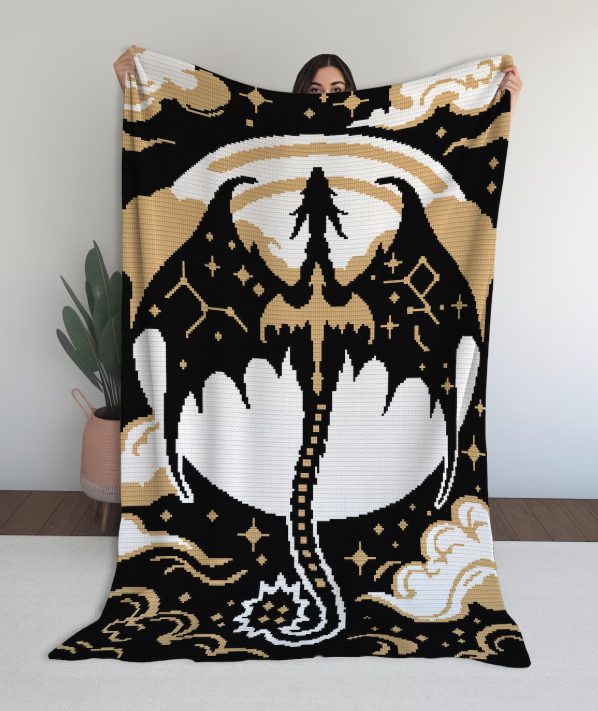
Crochet Dragon Blanket Pattern is a dramatic fantasy-inspired crochet project that combines the mystery of dragons, moonlight, clouds, stars, and contrasting colors into one impressive handmade blanket. Inspired by the reference image, this design features a large winged dragon as the central focal point, surrounded by a glowing moon, celestial motifs, clouds, and smaller fantasy details. The combination of black, white, cream, and gold yarn creates strong contrast and gives the finished blanket an elegant storybook appearance that works beautifully as a decorative throw.
Unlike a traditional blanket made from repeating granny squares, this Crochet Dragon Blanket Pattern is primarily an image-based project. The picture is created through carefully planned color changes across rows of crochet stitches. Techniques such as tapestry crochet, intarsia crochet, or a combination of both can be used to reproduce the large dragon silhouette and background. Although the artwork looks complex, crocheters can make the project much easier by dividing the image into sections and following a chart one row at a time.
The finished size can be customized, but a comfortable throw blanket is approximately 48–55 inches (122–140 cm) wide and 65–72 inches (165–183 cm) long. Because the proportions of the dragon are important, making a gauge swatch before starting is strongly recommended. This tutorial uses U.S. crochet terminology and explains a practical method for recreating the visual style of the reference while allowing you to customize the exact dragon silhouette and celestial details.
For this Crochet Dragon Blanket Pattern, a medium #4 worsted-weight yarn is an excellent choice. It creates clear stitches, provides comfortable warmth, and makes the numerous color changes easier to control than extremely fine yarn.
For an adult throw, approximately 3,000–4,000 yards (2,740–3,660 m) of yarn may be required depending on your dimensions, stitch tension, and chosen technique. Black will normally be the dominant shade, followed by white or ivory, with considerably smaller quantities of gold and cream.
The four main colors are black, white, gold, and cream/beige. Black establishes the night sky and dragon silhouette, white creates the brightest moon and cloud sections, and gold provides the magical highlights visible throughout the composition.
Use approximately a 5.0–5.5 mm crochet hook with worsted yarn. If your stitches are unusually loose, move down a hook size. If the fabric feels stiff, move up slightly. The finished blanket should remain flexible while keeping the image crisp.
The main abbreviations are ch (chain), sc (single crochet), hdc (half double crochet), dc (double crochet), sl st (slip stitch), st/sts (stitch/stitches), and FO (fasten off). For detailed graph work, single crochet is particularly useful because its compact shape behaves much like a small pixel.
Aim for approximately 14–16 sc and 15–17 rows = 4 inches (10 cm), depending on your yarn and hook. The exact gauge matters less than consistency, but changing tension midway through the blanket can distort the dragon image.
Begin the crochet dragon blanket from the bottom edge. For a blanket approximately 50 inches (127 cm) wide, create a foundation chain appropriate to your personal gauge. A starting width of roughly 175–200 stitches is common with worsted yarn, but your swatch should determine the actual count.
Row 1: Sc in the second ch from the hook and in every ch across. Ch 1 and turn. Continue primarily in sc when following a detailed graph because the short stitches make color placement more precise.
The lower portion of the reference contains dark background areas combined with sweeping cream and gold cloud motifs. Instead of trying to create complicated curves immediately, translate each area into groups of stitches. For example, work several black stitches, change to gold for the highlighted cloud section, and return to black according to your chart.
To change colors cleanly, stop before completing the final yarn-over of the previous stitch. Introduce the new yarn for that final pull-through and continue with the next color. This creates a cleaner boundary between the black background and gold crochet details.
As you progress upward, introduce small stars and celestial symbols. These can be incorporated directly into the graph using groups of gold or white stitches. Another option is to crochet the background first and embroider some of the smallest stars afterward using a yarn needle.
The enormous moon should gradually expand over multiple rows. Begin with a narrow group of cream or white stitches, increase the number according to the chart until reaching the moon’s widest point, then gradually reduce the width. Gold sections inside the moon create the layered luminous appearance visible in the reference.
Keep several yarn bobbins available instead of carrying every color across the entire blanket. Intarsia crochet is particularly useful for large isolated sections because separate yarn supplies reduce bulk and prevent excessive strands from showing through contrasting areas.
The dragon is the centerpiece of this Crochet Dragon Blanket Pattern, so accurate stitch placement is especially important. Before beginning this section, mark the horizontal center of the blanket with a removable stitch marker.
Start the tail near the lower center. Use black stitches against the lighter surrounding background. The tail should begin relatively narrow and gradually expand as it moves upward toward the dragon’s body.
For a pixel-style tail, increase its width by adding one or two black stitches at selected edges every few rows. Shifting the black section slightly left or right from row to row creates the curved movement seen in the reference design.
As you reach the body, gradually widen the black section. The torso should remain relatively narrow compared with the enormous wings. Maintain a strong vertical center line so the dragon does not appear visually unbalanced.
The wings require the largest color changes. Build each wing outward from the body using black yarn. Their upper edges should rise toward the outside corners while the lower edges form long pointed sections resembling the membranes of a bat or fantasy dragon.
White and cream areas can be introduced inside or behind the wings to create separation. The reference design uses a particularly effective contrast: the black dragon silhouette appears against a bright circular moon, making the wing shape instantly recognizable.
For finer details such as wing tips, horns, claws, and small spikes, use short groups of black stitches. Some extremely narrow features are easier to add afterward using surface crochet or embroidery rather than attempting a one-stitch-wide vertical line through many rows.
Continue upward until the dragon’s shoulders, neck, and head appear against the moon. Keep the head relatively small compared with the wings so the creature retains the elegant silhouette seen in the reference.
Create horns and head details using carefully positioned black stitches. Small protruding features can also be crocheted separately as appliqués and securely sewn onto the blanket if you prefer more dimensional detail.
The upper background returns predominantly to black, with scattered gold stars, clouds, and celestial accents. Maintain enough empty black space around these motifs so the design does not become visually crowded.
Once the final graph row is complete, do not immediately add the border. Lay the blanket flat and inspect the edges. Colorwork crochet can pull slightly in areas containing frequent yarn changes, so gentle blocking before the border can help restore the rectangular shape.
For the border, join black yarn in one corner and work 1 round of sc evenly around the blanket, placing approximately 3 sc in each corner. Follow with another round in black, cream, or gold depending on the desired finish.
A particularly elegant finish is Round 1: black sc, Round 2: gold hdc, and Round 3: black sc. This subtle gold line coordinates with the celestial highlights without competing with the dragon.
Finally, weave in every yarn end securely and block the completed dragon crochet blanket according to the yarn manufacturer’s instructions. Lay it completely flat, gently square the corners, and allow it to dry before folding or displaying it.
Is the Crochet Dragon Blanket Pattern suitable for beginners?
A simplified version can be attempted by an adventurous beginner, but the full design is better suited to intermediate crocheters because it involves frequent color changes and careful chart reading.
What crochet stitch works best for the dragon image?
Single crochet (sc) is an excellent choice because its compact stitches make detailed colorwork easier to control.
Can I use double crochet instead?
Yes, although double crochet produces taller stitches and may stretch the artwork vertically. The graph proportions would need adjustment.
What yarn weight should I use?
A #4 worsted-weight yarn offers a good balance between detail, durability, warmth, and manageable project size.
How much yarn is needed?
Approximately 3,000–4,000 yards (2,740–3,660 m) is a useful starting estimate for a large throw, but the exact quantity depends heavily on dimensions and gauge.
What colors are best for this pattern?
Black, ivory, white, beige, and metallic-looking gold tones create an appearance similar to the reference. Avoid uncomfortable metallic yarn if the blanket will be used regularly.
What is tapestry crochet?
Tapestry crochet involves working with multiple yarn colors to create images and geometric patterns directly within the crocheted fabric.
What is intarsia crochet?
Intarsia crochet uses separate balls or bobbins of yarn for different color sections instead of carrying unused colors across the entire row.
Which technique is better for this blanket?
A combination works well. Intarsia is useful for large sections such as the moon and wings, while tapestry techniques are convenient for smaller details.
How do I keep my yarn from becoming tangled?
Use small yarn bobbins for individual color areas and arrange them in the same order as the sections across your working row.
Can I make the blanket smaller?
Yes, but reducing a detailed graph too dramatically can make the dragon difficult to recognize. A smaller hook and lighter yarn can reduce the finished dimensions while preserving more chart detail.
Can I make it larger?
Absolutely. Increasing the number of stitches represented by each graph square can produce a much larger blanket.
How can I make the stars easier?
Crochet the major background first and add tiny stars afterward using surface crochet or embroidery.
Why does my colorwork look uneven?
Uneven tension during color changes is usually responsible. Avoid pulling the new yarn excessively tight when switching colors.
Should I carry black yarn underneath white stitches?
Usually not across large white sections because dark yarn can show through. Separate bobbins are preferable for high-contrast areas.
Does the blanket need blocking?
Blocking is strongly recommended because it helps straighten the edges and improves the definition of the graphic design.
Can I use different colors?
Certainly. Purple and silver can create a mystical dragon, red and gold can produce a fiery fantasy design, and blue with white can create an icy dragon theme.
The Crochet Dragon Blanket Pattern combines crochet colorwork with fantasy artwork to create a spectacular statement blanket. The large central dragon, dramatic wings, sweeping tail, luminous moon, stars, and stylized clouds turn an ordinary rectangular throw into a detailed textile illustration.
The key to making this project manageable is working systematically. Establish your gauge first, prepare the color chart, organize yarn bobbins, crochet the background one row at a time, and constantly check the center alignment of the dragon silhouette. Small errors are much easier to correct immediately than dozens of rows later.
The black, white, cream, and gold color palette shown in the reference is especially effective because it creates very strong contrast. However, the same construction method can be adapted to countless fantasy palettes, allowing each crocheter to create a completely different interpretation.
Take your time with the color changes and finishing details. Once the final border has been added and the blanket has been carefully blocked, the shapes will appear cleaner and the large winged dragon will become the unmistakable focal point of the project. If you make your own Crochet Dragon Blanket Pattern, leave your sincere opinion and suggestions about the colors or fantasy details you would add to your version.